This website has two main functions: To provide LID residents with information about our shared water system and secondly, to serve as a communications hub for alerting the LID community when time sensitive issues arise that may affect water supply and quality. Alerts will be posted on the website and also sent directly to the email or text message number you prefer.
On your first visit, please complete the brief registration form and tell us the best way to reach you. We expect that this will greatly increase the timeliness, coverage, and accuracy of need-to-know information to our community. Be assured that the LID Board will always protect your privacy and will use this information in no other way.
Thank you,
Bill Hamann, LID Board Chair
The LID currently operates a fully metered pressurized water distribution system with 98 connections, two 50,000 gallon reservoirs in separate locations, a 5000 gallon transfer tank and 16 wells approved and allowed under State of Oregon Water Rights Certificate 89534. In practice, only 14 of these wells are productive enough to be useful.
The State of Oregon Water Resources Department capped the maximum number of connections to the system at 98 households due to limitations presented by our aquifer.
The LID is operated under a set of rules and official by-laws and governed by a duly elected five person volunteer Board of Directors consisting of LID property owners.
The District is regulated by the Lane County Water Resources Division and subject to all Federal, State of Oregon and local regulations as they apply to this private water system. The system retains a State Certified paid systems operator and a paid accountant, both working under contract to the Board.
The entire water system belongs to the home owners on the LID, who are all equally responsible for it. One of the main points to understand about this system is that it does not have an unlimited supply of water, this is especially critical during the months of July, August, September. During these months the system can become stressed due to over usage from irrigation. It is imperative that each and every one of the LID owners do their part to conserve water.
The Lamontai Improvement District (LID) is a volunteer-led Oregon Nonprofit Corporation (501(c)(12), incorporated in 1972 to “construct and maintain a domestic water supply and distribution system” for LID property owners and residents. In carrying out this charge with limited water production and financial resources, the LID Board has set a water rate structure to accomplish three main goals:
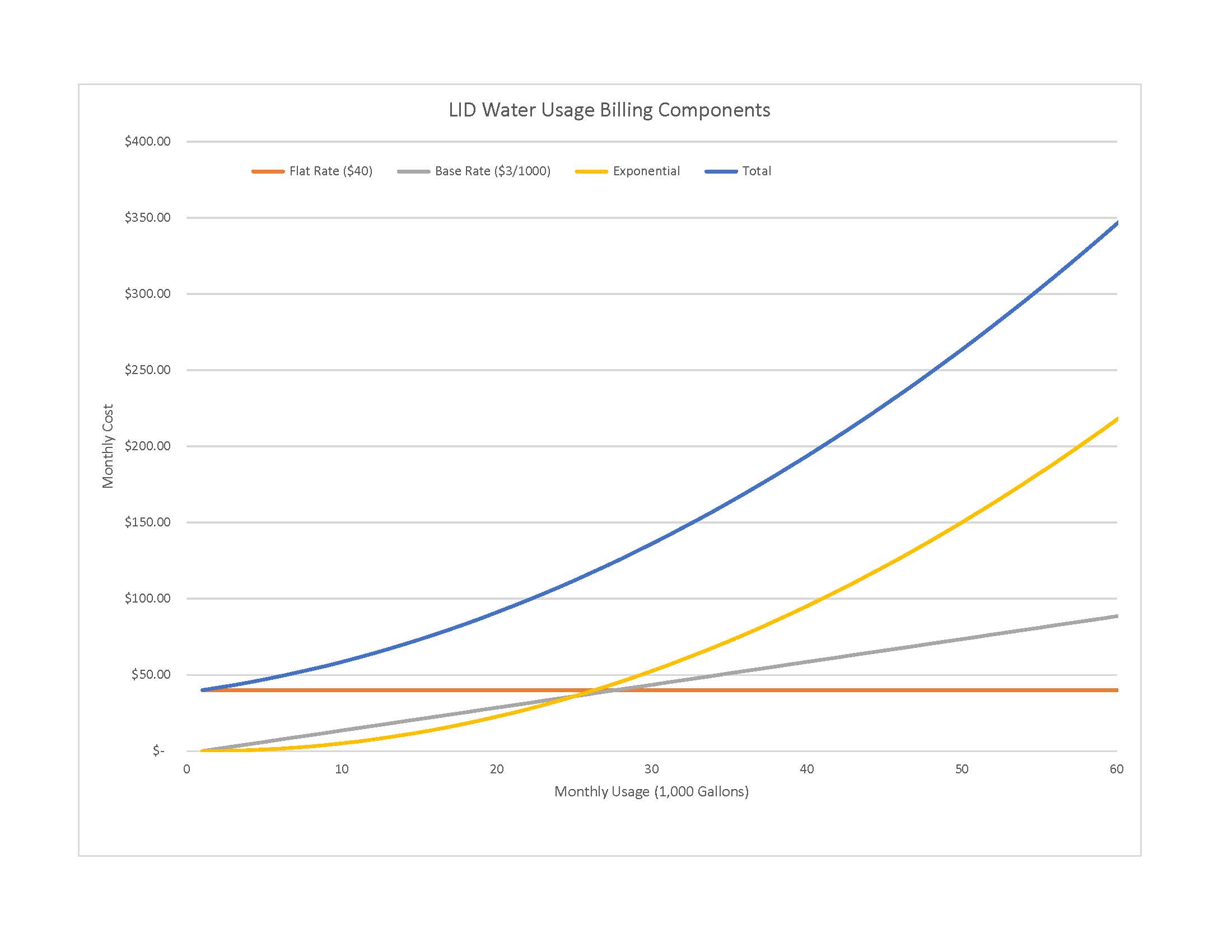
The underlying formula for our water rates is 40 + 3*U + 0.25*U^2 (where U is the monthly water usage in thousands of gallons). At first blush this can look fairly intimidating, but it is made up of three (relatively) simple components:
Three Examples:
These examples show how the exponential component of the bill increased dramatically with increased usage. From a small portion of the bill in the low-usage example ($2.25 out of $51.25) to more than half the cost in the high-usage example ($156.25 out of $271.25). The intention is to make the exponential component of the cost a light burden for low-usage customers, but have it grow enough to catch people’s attention when their usage increases well beyond the average.
If you like numbers and graphs then you can see this laid out in a table here or in a graph here. In both cases you’ll see that the $40 amount does not vary with usage while the $3/1000 component increases linearly (i.e., it doubles when usage doubles). The exponential component grows much more quickly — if you double the usage then the exponential component increases 4x. If the usage is below 10,000 gallons/month then the fixed ($40) and variable ($3/1000) components constitute most of the bill, but when you approach 25,000 gallons/month the exponential component starts to take over. Again, the intent here is to encourage responsible usage of a scarce resource.
In summary, the Lamontai Improvement District’s water rates are designed to cover our routine costs, provide a cushion for unexpected expenses and capital improvements, and promote responsible water usage.
To receive alerts and notifications from the LID, please provide your contact information. (If you’ve already filled this out, simply dismiss this popup!)